
Out now
90 Days With Your Nervous System
Not Against It
You already know the techniques. You have read the books. And at 11pm, when the spiral starts,
none of it is available to you.
That is not a willpower problem. Your nervous system is running on outdated information, and
information does not update through insight. It updates through repeated experience. This journal
is ninety days of that experience, structured so you do not have to work out what to do next.
Also available from The Great British Book Shop. Buying for a team, a practice or a school? Ask about volume copies.
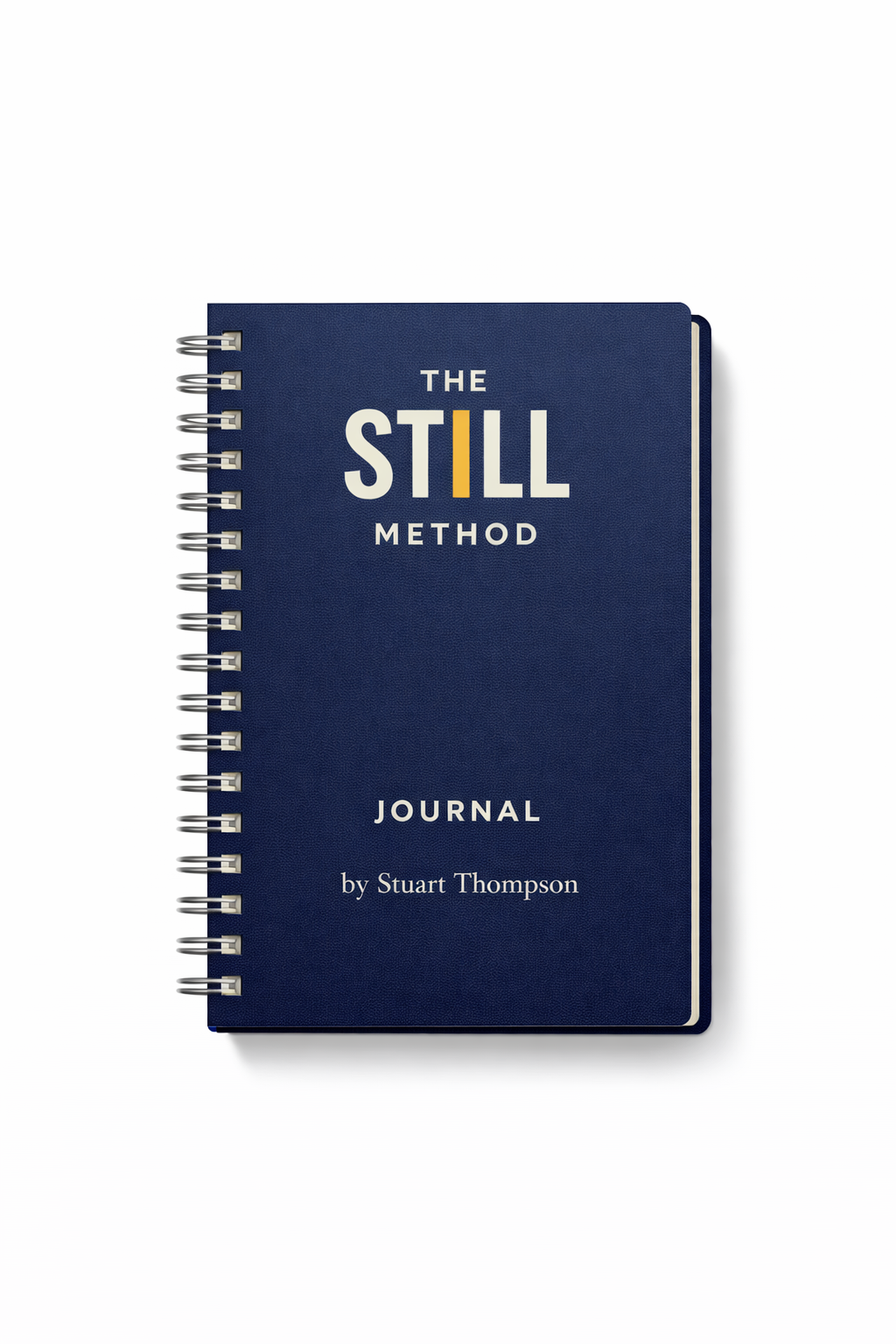
90 Days With Your Nervous System: Not Against It is a guided anxiety journal by Stuart Thompson, founder of The STILL Method. It applies the five stages of the STILL Method (Stop, Talk, Imagine, Listen, Learn) across ninety days of morning and evening entries, around ten minutes each, in three structured phases.
The approach treats anxiety as a nervous system running on outdated predictions rather than as a disorder to be silenced. It is 285 pages, Wire-O bound so it lies flat, printed in the UK, and costs £25.
You are not failing at this. You have been sold the wrong job.
The standard approach to anxiety goes roughly like this. Anxiety feels bad. The goal is to feel less anxious. So we develop techniques to reduce the sensation. Breathing exercises. Thought challenging. Distraction. All useful. All valuable.
And all of it addressing the warning light rather than what the warning light is indicating.
Anxiety is not a malfunction. It is your nervous system doing precisely what it was designed to do: scan for threat, predict danger, keep you alive. The system is not broken. It is running a simulation built from real experiences, some of them decades old, and presenting the output to you as fact.
The simulation is not always wrong. But it is frequently outdated, often disproportionate, and almost never as accurate as it feels. The work is not to silence it. The work is to update it.
What ninety days actually looks like
Each day has a morning entry and an evening entry, around ten minutes each. Each week has reflection points. Nothing in the sequence is accidental, and each phase builds on the one before it.
Stop and Notice
You observe your anxiety without trying to fix it. Where it lives in your body. What it predicts. What it makes you do. And, crucially, how accurate those predictions turn out to be when you check them against what actually happened. This phase feels slow. It is the foundation. You cannot change what you have not yet understood.
Talk and Imagine
You start responding differently. Small experiments. Language shifts, from "I am anxious" to "my anxiety is telling me". The change is grammatical and the effects are not. You teach the system new rules by giving it new evidence, rather than by arguing with it.
Listen, Learn and Celebrate
You build something that lasts. Which practices protect your capacity. What matters to you when fear is not making the decision. And what happens on Day 91, when the prompts stop and the scaffold comes down.
"I've been working my way through your book and it makes so much sense. As I read I feel like I can hear your voice. So straightforward and easy to follow."
Elaine, nurse and mum of two
Built to be finished
Clean pages. A structure that tells you what to do and, just as importantly, when to stop. No sprawling prompts. No three-page reflections. Wire-O bound, so it stays open on the table instead of closing itself while you write.
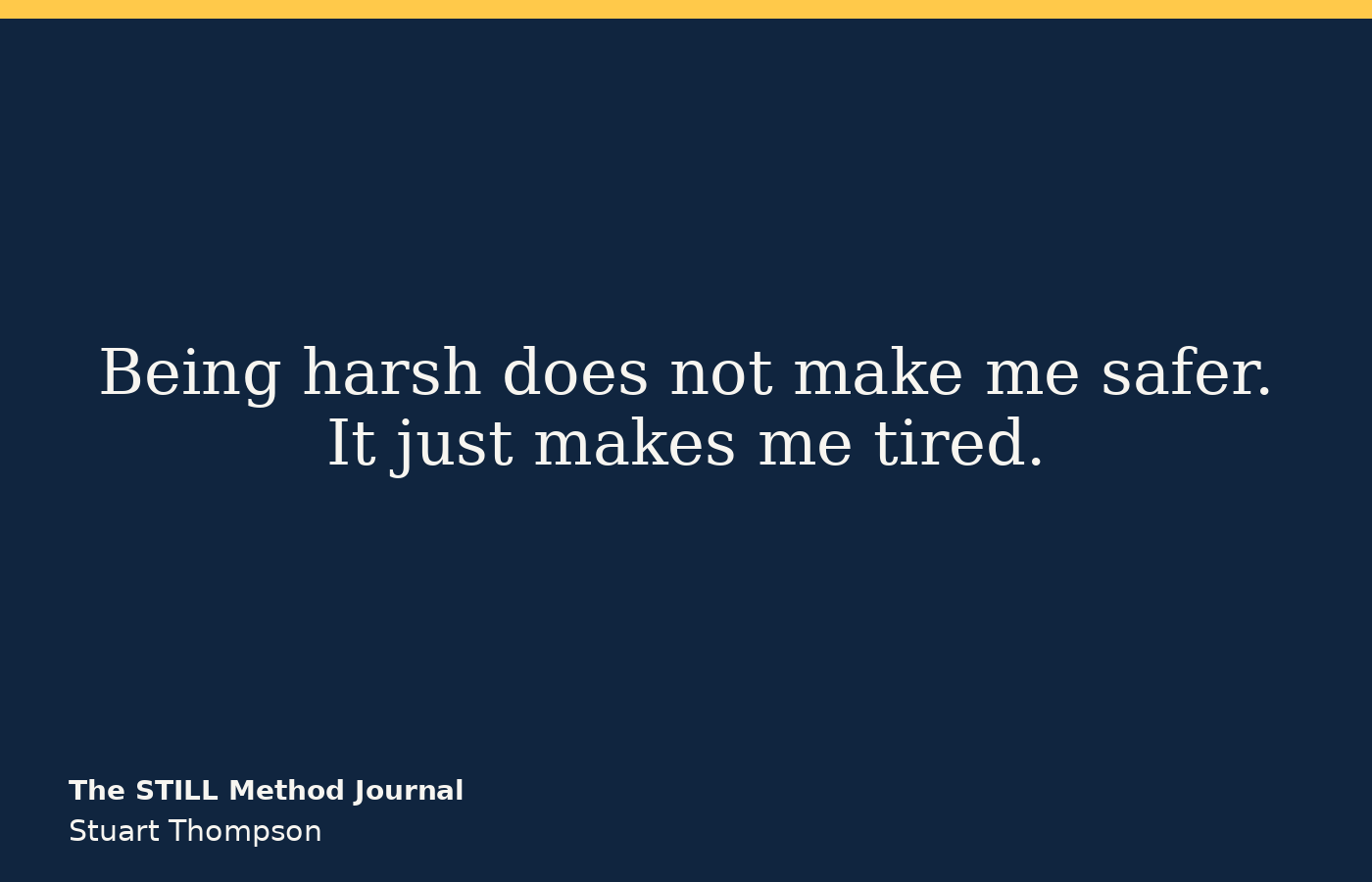
A page built to close the loop. You do it. You finish it. You do not carry it into the evening.
The thing most journals miss
Most journals give you a way in. They do not give you a way out. You write, you feel, you spiral, and you close the book having added more content to the anxiety rather than less. That is not a design accident. It is a design failure.
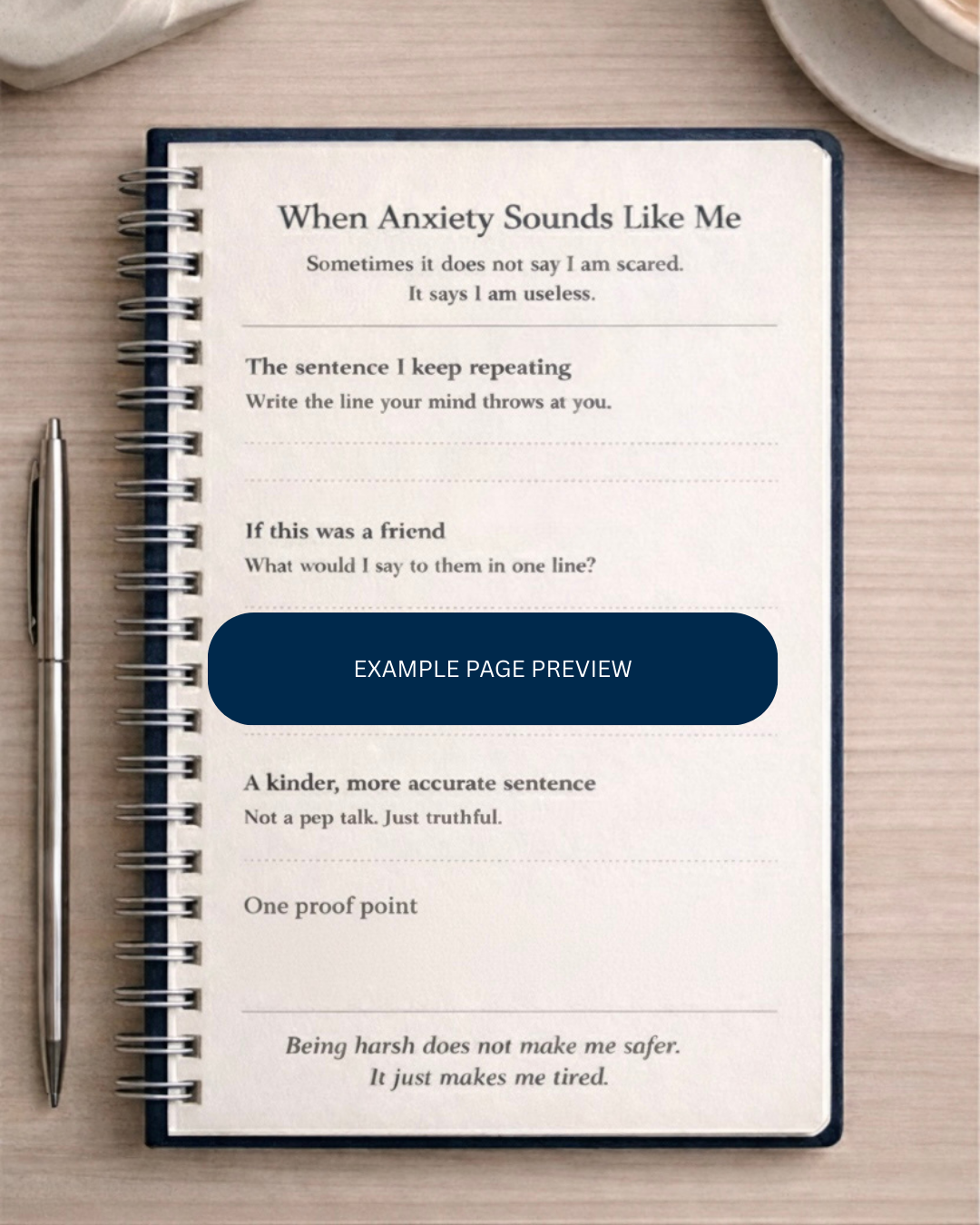
Every page has a finish line. You cross it. You move on. That is the whole point.
The reasons you are about to not buy this
"I have tried journalling and I hated it."
Good. So did most of the people this was written for. You are not being handed a blank page and told to feel your feelings. You are given a structure, you follow it, and then you stop. If you have ever closed a journal feeling worse than when you opened it, that was the format failing you, not the other way round.
"I will start well and then miss a week."
You probably will. The journal is built on that assumption. Missing days is expected and accounted for, because progress here is cumulative rather than linear. Returning is the practice. The only version of this that fails is the one where a missed week becomes proof that you cannot do it.
"Twenty minutes a day is a lot."
Compare it honestly. Not against twenty free minutes you currently have spare, but against the time anxiety already takes from you. The rehearsing. The re-reading of the message before you send it. The hour of lying awake. Twenty minutes is a reduction.
"£25 is a lot for a journal."
It is less than half the price of a single counselling session, and it is 285 pages of structured work rather than blank paper with a nice cover. If you use it and it does nothing, you have lost the cost of a takeaway. If you use it and the system updates, you have changed how you meet every difficult thing that comes next.
"I am not sure now is the right time."
There is no right time. That is the honest version. Ninety days pass whether you spend them examining the pattern or repeating it, and the reason most people never start is that the start is always available tomorrow.
Who wrote this
Stuart Thompson is the founder of The STILL Method, an accredited coach training organisation, and has worked in anxiety and emotional health for more than 25 years, including as a social worker. He is an ACCPH Fellow and a GHR Senior Member (SQHP). His work has been featured in The Guardian and on the BBC.
He is not an observer of anxiety. He has lived with it since childhood, learnt from it, and built a life that accommodates it while refusing to be defined by it. The preface explains how, and it is not the inspirational version.
What you are buying
- 90 days of structured daily entries, morning and evening
- Weekly reflection points that track behaviour, not mood
- Three phases that build on each other rather than repeat
- A Quick Tools section for the moments that will not wait
- Guidance for Day 91 onwards, when the prompts stop
- FormatWire-O bound
- Pages285
- Dimensions21 x 14.8 x 2.9 cm
- Published4 March 2026
- ISBN978-1-80738-604-7
Before you decide
Is this therapy?
No. Therapy explores where things came from. This journal changes what you do with them now. It supports a daily practice and does not replace professional care.
Will it work alongside therapy or medication?
Yes. It is a daily practice, not a competing treatment. Many people use it between sessions, precisely because it produces the sort of specific detail that makes those sessions more useful.
Do I need to know anything about the STILL Method first?
No. The journal explains the framework as you go. If you want the deeper version afterwards, the method exists as coaching, as professional training, and as a framework for schools and organisations.
Can I buy several copies?
Yes. Coaches, therapists, practices and schools can order volume copies on a single invoice. Get in touch and we will sort it.
Ninety days is enough time to begin.
Not enough time to become someone who never feels anxious. That is not the goal and it was never available. Enough time to stop treating the prediction as the verdict, and to have ninety days of your own evidence that you can.
Order your copy for £25Also available from The Great British Book Shop.