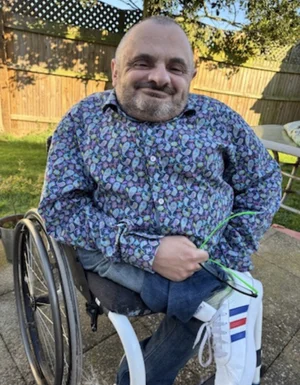
Why coping is not enough
By Stuart Thompson, creator of The STILL Method, an anxiety focused programme used in homes, schools and services, and by people who retrain as anxiety coaches
Anxiety is usually marketed in the same way as mobile phone insurance. Nobody quite believes it will make much difference, but it feels irresponsible not to have it. You are told you will always be anxious now, but with enough breathing, grounding and lavender spray you may be able to tolerate it.
The unspoken message is bleak. Your life is the same size, only now it comes with a permanent warning label. You can decorate the prison cell, you cannot leave.
I have never been able to accept that story, partly because of my bones.
I was born with brittle bone disease. I can quite literally break something doing what other people describe as getting on with their day. Standing up. Reaching for a mug. Turning to pick up a bag. If anyone has justification for designing a life entirely around fear, it is someone whose skeleton treats gravity as a suggestion rather than a rule.
At some point I had a choice that was both very simple and very unfair. Avoid as much of life as possible in the hope that nothing snaps, or accept that my body is unpredictable and live anyway. Build a life where fear calls the shots, or build a life where fear is consulted, heard, and then overruled when something more important is at stake.
Once you have faced that choice in your own body, it becomes very difficult to sit opposite a frightened person and say, with a straight face, that the best they can hope for is better coping.
I have watched people do more than cope. I have watched people recover.
Not recover into a life with zero anxiety. That place does not exist. Recover into a life that is no longer run as a subsidiary of the Anxiety Department.
Everyone is anxious. Anxiety is not a sign that something is wrong with you, it is a sign that something in you is working too enthusiastically. It is the same system that stopped you walking into the road at six years old. If you wait for the day you feel completely free of anxiety, you will wait for the rest of your life and possibly longer.
Recovery is not the day anxiety disappears. Recovery is the day anxiety stops deciding what you are allowed to do.
A child on the doorstep of school
I see this most clearly in stories.
One child I worked with simply could not get to school. This was not ordinary reluctance. Their body staged a full scale mutiny long before anyone mentioned attendance. Shaking, tears, stomach in knots before the uniform was even on. The default responses in our system tend to be either force or surrender. You drag them in, or you give up and tell yourself it is a phase.
Neither worked. They usually do not.
So we tried something that sounds insultingly modest on paper. We slowed down and treated the child as the expert on their own fear. Together we built a ladder, one tiny rung at a time. Not a glossy diagram in a workbook, but a list of steps that felt just the right side of impossible.
Stand by the front door for a minute. Walk to the car and then come back in. Sit in the car with the engine on, then off. Drive past the school, once, without stopping. Each step designed to irritate anxiety rather than overwhelm it.
At the same time we paid close attention to the body. In The STILL Method I teach what I call the six states of anxiety. That is a grand way of saying that panic does not just fall from a clear blue sky. The nervous system moves through recognisable phases. The tiny flicker of unease. The gathering tension. The mental rehearsal of escape routes. The full internal fire alarm.
Once this child could say, today I am in the build up state, rather than simply I feel awful, something important shifted. They had moved from being inside the storm to standing on a balcony watching it roll in. We experimented with ways they could steady themselves at each state, based on their own regulation style rather than adult imagination. Movement, chewing, drawing, rhythm, sound.
From the pavement outside, the change would have looked uneventful. They began to walk through the school gate. They managed part days, then full days. They made it to lunch without total collapse. No swelling music. No inspirational speech. Just a quiet, stubborn reclaiming of ordinary life.
That is what recovery looks like up close. It is oddly undramatic.
When a life shrinks around anxiety
Another story began in a very different place. A woman came to see me whose life looked sensible and protected on the surface. She avoided busy places, certain routes, particular people, the news, any situation that might provoke anxiety. Her calendar was the neat output of years of careful avoidance.
If you glanced at it quickly you might have called it good self care. In reality, her world was shrinking like a wool jumper in a hot wash.
This is one of the more successful myths of the anxiety industry, that the solution is to relax more. Someone is spiralling, so we prescribe scented candles, warm baths and time off. None of these things are inherently wrong, but on their own they do something very odd. They turn life off at the plug.
If the warning light comes on in your car, you can always remove the bulb. For a brief and glorious moment, the problem has gone. Until you actually need to drive somewhere.
A great many anxiety strategies amount to bulb removal. You stop travelling, stop socialising, stop working, stop risking. The light appears to vanish, but only because the engine of your life is now idling in the driveway.
With this woman, we did almost the opposite of what is usually recommended. We very deliberately restarted the engine.
First, we became slightly forensic about her nervous system. Not the textbook version, the personal one. How did anxiety first announce itself in her body. What happened when it escalated. Which signals did she reliably ignore until they became unbearable.
Then we tested ways of regulating that body that were specific to her. Not a menu of techniques copied from the back of a workbook, but an experiment. What actually helped her shift back towards safety. For some people it is breath. For others it is pressure, cold, movement, music, conversation, a sarcastic friend on the end of the phone. We kept what worked, discarded what did not, and built what was essentially a custom nervous system manual.
Only then did we ask anxiety to sit in the passenger seat while she drove.
Small, targeted experiments at first. A very short visit to a place she had entirely written off. A meeting she would previously have dodged. A bus journey that her anxious brain had red listed. She did all of this not once she felt calm, but while fully expecting to feel anxious and knowing she had tools when it arrived.
The turning point came out of her own mouth. Halfway through describing an ordinary weekend she paused, frowned slightly, and said, I have just realised my anxiety is not a life sentence.
Her anxiety had not vanished. Her world had stopped shrinking. Again, that is recovery.
What recovery really looks like
If you stand back and squint at these stories, a shared pattern appears.
Recovery is not the result of a single insight or one perfectly chosen exercise. It is what happens when someone understands how their own nervous system works, learns to recognise the early states of fear, discovers the specific things that bring them back towards safety, and then begins to imagine a life that is bigger than their anxiety and take steps in that direction.
That word imagine matters more than it looks.
In The STILL Method it is one of the five central pillars, and in recovery work it is usually the one that changes the weather. At some point I will ask a question that sounds disarmingly simple. If fear was not in charge of you, what would your life look like.
It is amazing how often people have no answer. Anxiety has been driving for so long that they have forgotten they are allowed to want anything at all.
So we do something very unfashionable. We let them want things.
The child pictures walking into school and still having energy left to play after. The parent pictures going to a busy event and coming home tired but not destroyed. The adult pictures travelling, applying for work, sitting in a cafe, without the constant requirement to get permission from fear.
Once that picture exists, recovery stops being a slogan and becomes a set of coordinates. You can begin to ask, calmly, what is one step towards that version of your life that you could reasonably take this week. Not a grand gesture. Just one small, disobedient act in favour of the future rather than the fear.
For the people who want to help
I am very aware that the people who read this are often not the ones who would be given a diagnosis. You may be the parent everyone quietly brings their worries to. The teacher who spots the child on the edge of the playground who never quite makes it into the game. The support worker, the manager in a workplace, the person who notices patterns of fear and thinks, surely there must be more we can do than telling people to calm down.
Some of you are already wondering whether your next career move is not another promotion in the same system, but a shift into work where helping people recover from anxiety is the main event, not a side effect.
If that is you, there are two things I would like you to hold on to.
First, recovery is real. I have seen it in children who once could not cross their own front step and now travel happily. I have seen it in adults who genuinely believed their only option was to arrange every detail of their life around anxiety and who now make decisions based on what they value rather than what they fear.
Second, recovery is messy. The graph does not climb smoothly. It loops, stalls, plunges and climbs again. Which is precisely why a structured way of working helps. In my world that structure is The STILL Method, with its focus on fear and safety, on the body as well as the mind, on prediction as much as reaction, and on giving people not just relief in the moment but a protocol for reclaiming their lives.
I teach that approach partly for selfish reasons. There are more anxious children and adults than I will ever meet. If recovery is to be normal rather than exceptional, we need more people who know how to guide it. If you are already the person others turn to when anxiety takes over and you feel a pull to make this your work, that is exactly who our STILL Method training is built for, whether you come from teaching, care, therapy or are changing direction completely.
You do not have to decide anything dramatic at the end of a blog. If you want a practical next step, choose this. Notice one anxious person in your world this week and watch, with a slightly more curious eye, how their life is being quietly shrunk by fear.
Then ask yourself, not could they cope better, but what might it look like for them to recover.
If that question refuses to leave you alone, that is usually where the interesting work begins.